Categories
Reports

William Wilberforce, Wow!

Reading Time: 4 minutes

51a-TSyuh9L

A miracle, according to the New Oxford English Dictionary, is a surprising and welcome event that is not explicable by natural or scientific laws and is therefore considered to be the work of a divine agency.

With that definition, I’d have to say that William Wilberforce’s life was jam-packed with miracles. Left and right you can see divine influence, without too much assumption. The story of a man who had the guts to stand against all of the nastiest people in the country–in the world, really–wasn’t one of glamor, or glory. No, the hardships were extreme, and the consequences dear, but the results are still in effect.

In an attempt to tell of two main miracles in William Wilberforce’s life, I’d have to start at the beginning. He was born into a moderately well-off family, and didn’t want for food or shelter. That leads to the first miracle: Wilberforce was very spoiled, because of his “societal class,” and he grew into a charming party animal. Friends with all, and well-practiced in the art of public speaking, he was geared for success in a life of politics.

As he grew beyond childhood (making beyond ten being a miracle at that time in England) he was sent to his aunt and uncle’s home. They continued his upbringing, and he was converted, during his time with them, to a radical Methodist. At the time that was considered to be, well, radical. The “Methodists,” or “enthusiasts” as they were derisively dubbed, were scorned for their enthusiasm towards evangelical activities. They were considered uncouth by the elite of the culture and society. [Look up George Whitfield] This is miracle number two: Wilberforce, until this point, had lived rather frivolously, due to his significant monetary benefits. He was able to do anything he wanted, and he wanted to have a good time. He was smart but lacked direction. In this section of life God gave him direction. This helped Wilberforce realize the incredibly evil contrast between his life, and the lives of the slaves.

Further into his life, Wilberforce has gained a reputation. He is a witty, charming, and kind politician fighting for the rights of all men, because all are equal. He’s proposed and passed bills to stop public burning, and has reduced the laws punishable by public hanging by nearly half and half again! He’s becoming quite accomplished, but he knows his work is nowhere near finished. Slavery is still rampant at this time.

To properly frame the situation I have to explain a bit. When I say slavery, or racial injustice, you think of the Civil War maybe? The whites in the South? The Triple K? Or the Brown v. Board of Education case?

Take all of those horrendous things and defenestrate them. Now think of the very worst racial injustice you’ve heard of and double, if not triple it. The process is disgusting.

These slaves were stolen from their homeland of Africa and forced to lay horizontally stacked, one upon the other, until you couldn’t fit anymore because of the ceiling. Then, if they weren’t dead at the end of the trip, because of indescribable horrors, then they were taken to fields in America, or in any other colony that the British could use them at, to work until they broke, or died. It was a lucrative trade that many were loath to part with, but at it’s core it was evil, and many sensed that.

Wilberforce fought for years upon years, and slowly chipped away at the massive institutionally accepted evil, and eventually gained some credence. Many of his friends laid their professional lives on the line for his cause, and helped him fight the slave trade. Eventually, after endless trials and underhanded schemes being thrown at them by large corporations (such as the British East India Company, which essentially governed India) Wilberforce prevailed, derailing what at the time was probably the most integral trade in the British Empire.

To correlate everything, I’d like to point out that Wilberforce never would have been so empathetic with the slaves if he hadn’t become a radical Methodist when his mother sent him to his aunt’s. That event alone was life-changing, and -shaping. He was changed from the well-educated, charming ne’er-do-anything-of-import that he was, to a deep thinking and pious man.

He also wouldn’t have been so self-condemning, if he hadn’t had his previous life as a well-to-do British elite.

The implications are astounding, aren’t they? Let’s go step by step, taking a few liberties.

God places Wilberforce into a rich family, Wilberforce grows; he learns academically–earning degrees necessary for a career in parliament–and personally–he develops his personality: wit, charm, and eloquence. Then, Wilberforce throws everything for a loop. He doesn’t have any ambition. Everyone likes him, and he just wants to enjoy life. God says, “No, you’ve got bigger things to do,” and sends him on his way to his Aunt’s by manipulating extenuating circumstances. Wilberforce becomes a Methodist, this leads to the cure of the world’s most deadly disease: slavery.

It’s amazing to see that through one man, God changed the world, taking in stride Wilberforce’s own decisions, and using them for the benefit of the world.

That shows me, more than anything else, God will forgive any sin. Not only that, but he’ll use that sin to the benefit of you, your family, the world?

The possibilities are endless. Luke 1:37, Luke 18:27.

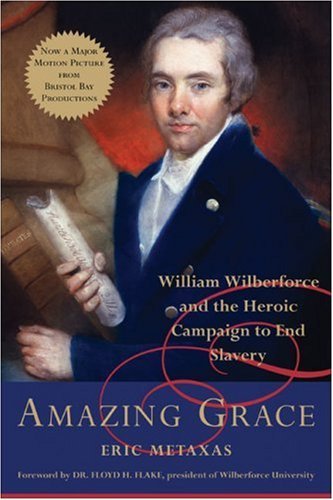
For anyone looking to read more on William Wilberforce, the book that I read is Amazing Grace by Eric Metaxas (above). It was comprehensive, as far as I could tell, and well written. And if you don’t want to read a scholarly work such as that, then Wikipedia is open 24/7 🙂
Categories
Uncategorized

J. Edgar Hoover Wouldn’t Approve of This Message (PART 2)

Reading Time: 4 minutes

Picture 5When writing about a bad guy, I’ve stated before, you must make him realistic. He must be lovable, as well as hatable. He must have qualities, or goals, that are noble, and worthy of praise.

J. Edgar Hoover was exactly such a man. He was a fine, upstanding citizen, raised in the early twentieth century. His goal was to organize, and run, an exceptionally efficient organization, known as the FBI.

Hoover was quite efficient in all of his ways. He discussed, with an advisor, that wanted criminals would have less of a chance of escape if he deputized more agents. Shortly thereafter Hoover developed the Ten Most Wanted list. Hoover’s desire to lower the odds for criminals translates to one of the best law enforcement agencies in the world. The FBI is also one of the most feared among gangs, the Mob, and the Mafia.

The start of Hoover’s problems (or the problems Hoover caused), was closely related to his beginning at the FBI. When he became the director, Hoover started throwing the bad guys in jail. To quickly summarize, Hoover was dealing with the most famous gangsters, killers, and kidnappers of his time. They were dealing with an organization that they thought was porous in its law keeping. Hoover surprised them, and they all went to jail. Hoover got his first taste of perfection, and victory.

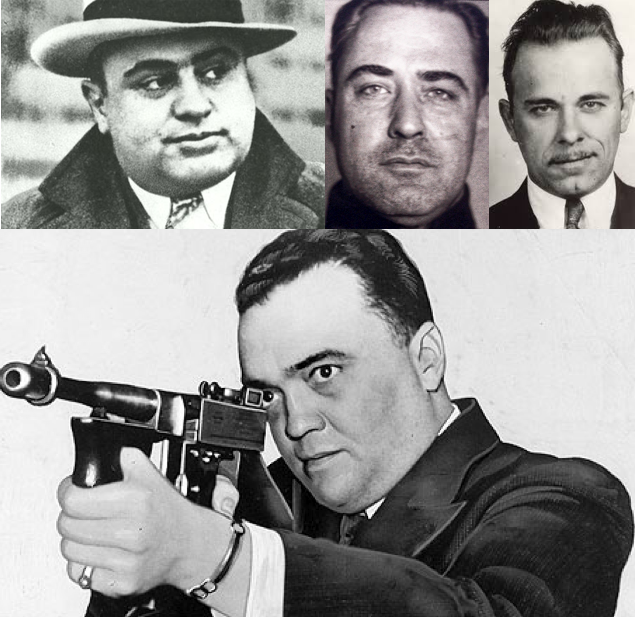
He locked up Ma Barker and her boys, Herman, Lloyd, “Dock”, and Fred. Alvin “old creepy” Karpis joined them sometime around the late 1920s, and the early 1930s. Technically the FBI never locked up all of them, as most of them committed suicide before they could be captured.

Hoover also killed, or put away, “Pretty Boy” Floyd, “Baby Face” Nelson, John Dillinger, and Bruno Richard Hauptmann (Charles A. Lindbergh Jr. kidnapper.) “Machine Gun” Kelly, Al Capone. All of the famous bad guys.

During the Prohibition, Hoover and the FBI were quite active. Drinking is something that many people do, and the fact that it was illegal doubled if not tripled the number of drinkers. People like illegal things. (Not to mention, selling it to addicts would make any bootlegger a fortune.) Point is, there were a lot of shoot-outs, and since “the manufacture, sale, or transportation of intoxicating liquors within… the United States… is hereby prohibited,” the FBI had a certain amount of jurisdiction, as the law was passed over the entire country. Thus making it federal law.

All of the success lead to the “G-Men”. No, not the New York Giants, but the Government Men. The name stuck, after a cornered “Machine Gun” Kelly reportedly cried out, “Don’t shoot, G-Men, don’t shoot!”

G-Men craze came in the form of children wearing G-Men pajamas, and playing with toy G-Men machine-guns. There was even a G-Men magazine, and subscribers of said magazine were taught how to get finger-prints using flour, and they were taught the G-Men secret whistle (two long, and one short).

During all of this Hoover developed his micro-management skills. He made sure that the FBI had a perfect reputation, and, most importantly, he made sure that the FBI got all of the big publicity cases. If Hoover knew one thing, it was how to play the system. Big publicity, equals free advertising. Hoover got the FBI’s MO out through the newspapers, and he didn’t have to pay. The MO was “We’re large, and we’re in charge.” It struck fear in the hearts of small crime-fighting operations, and criminals alike.

During the cold war, Hoover was definitely an anti-communism guy. Another one of the good/bad sides of him. He hated communism… so much that he was radically against it. When President Harry S. Truman signed the Executive Order 9835, in March, 1947, I can see Hoover dancing a jig with sheer glee.

The Executive Order initiated the Federal Employees Loyalty and Security Program. It applied to all two million federal workers. Anyone who was believed disloyal could no longer work for the federal government, although the term “disloyal” was never defined. Any employee could be dismissed, and any applicant turned down if there were “reasonable grounds for belief that a person is disloyal.” (This is the type of power that the Founding Fathers did NOT want the government to have.)

Keep in mind that during the cold war, the entire country was commie happy. Everyone was a communist if they did anything out of the ordinary. You were a commie if you sat at the same table every time at the local diner. You were a commie if you sat a different table every time.

The FBI investigated 14,000 employees, on the aforementioned grounds, and J. Edgar Hoover still wasn’t happy. He described communism as a disease that the USA needed to constantly guard against. With Executive Order 9835’s wording leaving everything to interpretation, Hoover was able to place wiretaps in peoples phones and such, if there was even a bit of suspicion.

“Mr. Hoover, sir, there’s this one guy who doesn’t look like a commie, doesn’t act like a commie, doesn’t eat like a commie, doesn’t talk like a commie–”

“Say no more,” Hoover would reply. “Wiretap his house, just in case.”

Hoover’s critics would constantly cite the small number of communists in the USA. Hoover would always reply, “It took only twenty-three men to overthrow Russia.” He obviously believed it could happen here.

That was one example of Hoover’s over-reaching paranoia. Hoover was good friends with Senator Joe McCarthy. Go figure. McCarthy was one of the worst kidney-punching sleazeball ever. He developed a low-blow type of politics. It’s called McCarthyism, defined as, “the practice of making accusations of disloyalty, especially of pro-communist activities, often unsupported or based on doubtful evidence.”

Point being, Hoover, and McCarthy, were both insanely against communism. Problem was that they both used the issue to investigate or eradicate political enemies, or anyone they deemed pee-pee ants.

Hoover was doing the wrong things, but for the right cause. It’s the ultimate bad/good, good/bad struggle that every author wants for his antagonists. Unfortunately for you, my tired reader, there’s more.

Bye for now,

Ian, the writer soon to be searching for a book, or several articles on concise writing.


Categories
Uncategorized

J. Edgar Hoover Wouldn’t Approve of this Message

Reading Time: 6 minutes

J. Edgar Hoover

I have recently (within the last month) read two books on the man known as J. Edgar Hoover.

He was evil.

As a writer, I strive to create really good bad guys. Antagonists must be authentic, not your everyday, I’m-gonna-take-over-the-world-for-no-reason-other-than-I’m-a-megalomaniacal-megalomaniac type bad guys. I strive to make them three-, four-, even five-dimensional. If they appear human, and are lovable, and hatable, I feel accomplished.

One way I try to get the readers to love my bad guys is by making the bad guys’ goals charitable, noble, worthy, and honorable. If I have the bad guys trying to accomplish something that is right, or that they think is right, I’ve got a even more conflict for the reader. “Is the good guy doing the right thing? Is the bad guy going to win? Do I want the bad guy to win? Do I want him to lose?”

Readers eat that stuff up. They like to worry about the characters. (At least that’s what all of the books on writing fiction tell me.)

Either way, J. Edgar Hoover would make the best bad guy ever!

John Edgar Hoover was born in Washington D.C., January 1st, 1895. Quite punctual, as usual. Well, he hadn’t any “usual” yet, as he was just born, but… well, it set the standard I guess. He lived in the same house for the first 43 years of his life, a very Hoover-esque thing to do.

He was a good kid, always kept his nose clean. “As a youth I was taught basic beliefs,” said Hoover. “For instance, I was taught never to put another book above the Bible.” Hoover never drank with any of the other high school students, instead he found companionship with his family.

Another lovable quirk was the fact that he had a stutter. As a perfectionist, he knew this was unacceptable. In order to avoid it, he developed a machine-gun-like manner of speaking. (Awwwwww! Iddindatsocute?)

After graduating high school, Hoover took a job as a messenger and file clerk at the Library of Congress. He learned the incredibly complex card-index system, and learned it with a hunger. He worked at the Library for four years while earning a degree in law at George Washington University.

Hoover was a man with a plan, and a man with a purpose. Many recall that he seemed more purposeful than most anyone else. His niece, and superiors were among the ones specifically quoted in the books.

In July, 1917, he his law degree, and took as a clerk in the Justice Department (JD). Within three months, he had gotten a promotion. Over the next seven years of his career at the JD, Hoover would get promotion after promotion. After two years on the job, he was considered the JD’s expert on aliens.

In August, 1919, Attorney General A. Mitchell Palmer appointed Hoover the head of a new division, the General Intelligence Division (GID). Its job was to “research” (spy on) political groups that the government deemed too radical, and thus dangerous. U.S. political groups!

Using his index-card experience, Hoover created a filing system for the GID. The index contained information on 100,000 individuals who were considered political extremists. Within a few months this file had grown to 200,000 individuals. By the files third year of existence the number exceeded 450,000. Not content with this list, Hoover created a list of the 60,000 most dangerous.

I’d like to point out that this man was already overreaching his bounds. The GID is a department of government that is highly unnecessary, and I believe is part of the reason Hoover was in on the Watergate Scandal. He felt that the government had power, and he was twisted by that power. Twisted so much, that he did things that he never should have done. Watergate was just one of those things.

Hoover also hated communism. Another good point in this strange man. He wrote, “Communism is the most evil, monstrous conspiracy since time began.” He preformed a study on it, and quickly established himself as the nation’s number one authority on the subject.

Look up the “Palmer Raids”, and you’ll see what kind of control freak Hoover was. Hoover was in charge of planning them, and the total control factor really shows up. He arrested many, many, many people on suspicion, and it was one of the most shameful times in America. America is a country that advertises freedom, but this was an act worthy of some Nazi, or Communist state.

One year after the Palmer Raids, in August, 1921, Hoover, just 26 years old, was named the assistant director of the Bureau of Investigation (the FBI before the F, which is followed by “ederal”).

Now, before we go any further, I should explain about the old Bureau. The one with BI for it’s initials. (BI stands for Bad Intellect)

The bureau was a place that was full of irregularities, such as a system used in one Field Office, but no system whatsoever in another Field Office. The Agents were awful, getting into trouble left and right. Drinking a lot, and even drinking while on the job. The FBI, I mean BI, was finding more criminals inside its walls than outside. Hoover was ticked.

He set out from day one to fix the BI’s horrible system. He was taking over at a time when people where beginning to seriously question the bureau’s integrity. Image was everything to Hoover, and he was ready to get busy.

Hoover noticed an extreme lack of focus in the personnel, and made them one of the top most priorities. Yes, plural, the Bureau wasn’t a very well run organization. In fact, it wasn’t a very organized organization.

Hoover started by firing all agents who had a criminal past, or whose character was in question. Those who weren’t fired were retrained in “the way of the Hoover” as someone put it. Agents Hoover disliked, but he couldn’t fire without causing suspicion, where driven out by short-notice transferring. The agents reffered to it as being “on the bicycle.” Any agent on the short-notice list would be ordered to pack his bags and report immediately at his new post. It would go on and on until the agent resigned. Still others weren’t fired, but they quit because they didn’t want to work under the strict rules enforced by Hoover.

Hoover also installed an entrance exam. Citizens of the U.S. who were white males, between the ages of twenty-five and forty, had 20/20 vision, good hearing, and good health were eligible to apply. Those who had law or accounting degrees were given preference, as Hoover thought they’d be more professional in their evidence collection. Hoover believed the un-professionalism of the Bureau was the leading cause of its failure to win any cases.

Hoover was also the first directors to train the agents in the use of weapons. The agents were trained how to be an expert shot in revolvers, rifles, shotguns, and machine-guns. They were also taught how to launch tear-gas bombs accurately.

When Hoover became the director of the FBI (it was the FBI then), he set the standards to include all of the Bureau’s employees, including typists, file clerks, and lab techs. No drinking on or off the job. Unseemly behavior wasn’t tolerated. No coffee breaks, and personal property at desks was completely prohibited.

Hoover also installed a inspection system called the Internal Inspection Division. Agents from the IID would show up at Field Offices at least twice a year, and give out merits to FBI agents who preformed well, and give demerits to those who didn’t. Merits could result in a promotion or a raise, and demerits could result in a transfer to an unpopular location, and then finally to dismissal.

Hoover said, “I want the public to look upon the Bureau as a a group of gentlemen. And if the men here engaged can’t conduct themselves in office as such, I will dismiss them.” Before long, the agents were considered men of goodwill, and great character. This was due to the strict rules, and Hoover’s ever-watchful eyes. He found that the TV show, the FBIhad a scene in which an FBI agent was alluded to driving a little above the speed limit, and he ordered the speed reduced.

Each script for the show was reviewed by Hoover himself, and every detail during the filming process was watched by a hawk-eyed agent. If an actor held a weapon incorrectly the agent corrected him. If an actor had anything criminal in his past, he wasn’t allowed to act in the show. The actor that played Inspector Erksine was hand-picked by Hoover. Everyone that was on the set was background checked. Even the electricians, and the carpenters used to create sets, had to be cleared by Hoover.

All so that the FBI’s reputation would be saved. Hoover was a man who knew how to work the political system. Don’t back down. Stand your ground, and make sure you hold all the cards.

To close part one: Doesn’t Hoover sound so relatable. He works hard, he learns quickly, he’s simple, and he brilliant. He’s assertive, and meticulous. Maybe not your favorite boss, but he’d be a great son, right? Perfect, and self driven.

This adds to my bad guy analogy. Hoover was a very well kept citizen, who grew up in Washington, D.C. He was raised so that he had strong morals, and was fine man. He loved his country, and hated communism. So far, so good.

Hoover, as I have said, was a control freak when he took over the FBI, and that was something that would permeate the rest of his career. Overall, Hoover is likable, for the most part. He’s a good guy who fixed a corrupt FBI, right?

Wrong.

TO BE CONTINUED


Categories
Reports

Chariots for China

Reading Time: 4 minutes

Eric Liddell. Oh, Eric Liddell. Let me count thy wonderful deeds!

Okay, enough of that.

Eric Liddell is known for his racing. Albeit strange, his running style won him many a race. His formula was simple: Run as fast as you can for the first part of the race, and ask God to help you run faster the second part.

Eric’s decision to forgo a race that was held on Sunday was quite shocking to his countrymen. He chose not to race in the event he was favored in, thus giving up a chance at a “sure” gold medal.

Eric ended up winning a gold in the event he was the given the least chance in. He was held in great regard by many who had disowned him after he had “dishonored his country”. And many of the others had stuck by Eric through the whole escapade.

After Eric’s success at the games in Paris, he decided to go back to China, where he had been born as a missionary child.

He returned to his birthplace, and started to help his parents do missionary stuff. One funny thing is that the head of the Anglo-Chinese School insisted that Eric and his family live in the French concession, in a huge house. Eric was, in fact, a British hero.

Eric begin his work as a teacher at a high end school. The founder of the school started it because he realized the need for mission work to the rich. He saw the poor being helped, but not the rich. I personally thought this was pretty ingenious. You don’t throw your net over someone else’s net. (See “I don’t understand fishing metaphors!” Cloudy with a chance of Meatballs)

Anyway, after a while Eric married a Canadian doctor, who wanted to be a missionary to China. Her name was Florence.

Then they had two girls in quick succession. Patricia and Maureen.

After five years or so, Eric was asked to help in a town that was in a war zone. China was still in the middle of the Sino-Japanese war. (If you say, “Huh?” you’re not alone. The Sino-Japanese war is also called the Forgotten War.)

He prayed about it and decided that he would go and help the town. He was quickly enrolled as a nurse’s assistant, and quickly became busy.

He became proficient in first aid, and was able to treat minor injuries, and the like. He would also travel to neighboring towns in order to help others have access to the hospital. (It was the only one for miles, and the Japanese had confiscated most vehicle, carts, etc.)

There was one time in which he was to retrieve a man who had been slashed across the face and neck, nearly decapitated, by a Japanese soldier. Eric and a man who had come along with him, rode the man back to the hospital on Eric’s bike. Along the way, Eric’s convoy was shot at by some Chinese men who thought they were Japanese.

Eric realized then that they were in a real war zone. Riding a bike could get you killed, albeit a case of mistaken identity.

After a bit of serving in the towns, Eric was granted permission to return to the English concession, and continue working at the school as a teacher. He lived there with his wife and daughters, and then they went back home on the basis that it was too dangerous for a wife and children in China. The Japanese had already regulated travel out side of the concessions, and Eric knew it was time for them to return.

It wasn’t quite time for his furlough, so he stayed it out, but then was restricted from returning by the Japanese. They said that the foreigners would be aloud to return to their homes, as soon as they were notified.

But the foreigners were soon notified otherwise. The Japanese had decided to put them in an interment camp.

It was run so as to keep the Europeans happy, but it wasn’t perfect. They had to fix the sewage system, and there wasn’t a lot of space. only about a football field’s worth for a few thousand people.

Through it all, Eric led the discombobulated upper class through the hardships. Many of the interns were not used to the hard living as Eric was. In many of the small towns in China, he had slept on wood floors. Hay was a luxury.

Eric was always smiling, and organizing games, classes, and youth group activities.

Eric died in the internment camp of a brain tumor. He was 43, and the only consolation for his wife, was that there was no cure for a brain tumor in 1945, and she knew it.

In all of the written accounts of the internment, there is a reference to Eric, or Uncle Eric, as many of Eric’s little friends called him.

Many remembered him as “constantly smiling”, or “The best christian man I knew.” There are countless other accounts with similar praise, as Eric was truly filled with God’s love, and he showed it in every action.

Eric Liddell was remembered in Scotland, his native land, by an award, that went to the first place racer in the top collegiate competition.

He is, and should be, remembered by all, as a man who truly loved God.

He gave his life to him, all 43 years of it. That’s pretty special 🙂